
On Thursday evening I took a “Lima by night” tour which consisted of a driver, a guide, a cute couple from New Jersey and me. The majority of time was spent in the van as the driver navigated rush hour traffic, which doesn’t seem much different than regular day time traffic. (Think Lincoln Tunnel or GW Bridge in New York.)
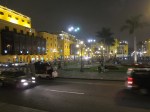
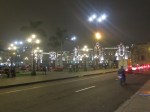
We got out of the van once to take pictures in the city center, but the rest of the time, the driver educated us on Peru’s economy, culture and traditions. We saw the exteriors of the Cathedral, major museums, San Francisco monetary, the President’s palace, court house, tallest building in Lima, etc.
Some cliff notes from the tour:
- Peru is a mish-mosh of different culture due to its history, Asian influence, combined with the geography: highlands, coast, farming communities and the city of 9 million people.
- The remote parts of Peru are rich with minerals including gold, silver and copper. Gold and silver are important to Peruvians since they represent the duality of the sun and moon. Even though it’s a Catholic country on paper, people are very focused on mother earth and take their cues from the land.
- Lima is an extreme city where the rich are rich and the poor are poor. In the 1980s and 1990s, there were a lot of shanty towns around Lima where people commuted into Lima to try and make it rich. Now in 2012 people have a lot more money which is certainly reflected in the stores we saw: designers you’d find on Newbury Street next to large casinos that look like they belong in Vegas next to a storefront with the metal gates (a la Brooklyn) to protect the store from criminals.
- There are still a lot of street vendors in Lima trying to make ends meet by selling water or newspapers at the side of the road. The unemployed do not receive any help from the government which contributes to the extremes for the haves and have nots.
- Everyone knows they need to earn money and takes their role as breadwinner very seriously, often providing for an extended family. For example, if a woman has many children and no husband, she takes it upon herself to make a living. Women in Peru are very motivated; they do not sit back idly and wait for government hand outs. Many work as maids in the wealthier districts and that pays well.
- Lima has a history of slavery, and five yeas ago the president of Peru apologized to the Chinese government for the actions of the Peruvians at the end of 19th century. Rich families had Chinese cooks – it was a sign of status – and that is how lomo saltado became so popular.
- We discussed how nothing has a fixed price: there are no taxi meters and all types of shopping (except high end stores) will negotiate on price.
- There are three major soccer stadiums – we drove past estadio nacional. The second most popular sport in Peru is surfing.
- There are a fair amount of earthquakes in Peru so we drove through an area with no tall buildings since that area seems to get hit hardest in the city. The citizens are waiting for a big quake and know that they are due. 1974 was the last big quake for Peru.
- We observed a lot of police and crossing guards. Plus, security wearing green jackets differ from the police. They are neighborhood security without guns hired by residents of a community to look for suspicious activities.
- Near the city center there were a lot of people doing tricks on the streets for money. Cirque du Soleil has recruited three street performers from Lima to join their troupe.
- Due to massive crime and terrorism in the 1980s, the downtown of Lima has really cleared out. There are many beautiful buildings but they sit empty or act as storage until companies move back downtown.
Contrast the 1980s to today: the streets are clean, there are no children on the city streets begging, etc. That being said, everywhere you go you still see metal gates in front of doors, tall walls in front of buildings, no open courtyards – everything has barricades. On tops of buildings and walls and really any place someone could stand to break into a building, there are metal spikes. Similar to what you might see in a neighborhood in NY or Miami, but this is everywhere – every building, corner, ledge or platform.
Another architecture note: many of the buildings have balconies that aren’t completely open to the street. They are enclosed, made of a dark wood with an intricate design. These balconies result from a strong Arab influence in Lima. The intricate design allowed women to see out of their residences without being seen by people on the street, so they did not have to remain covered up all the time.



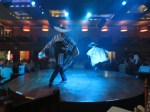
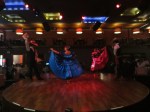
After the tour, we were brought to a tourist restaurant. Greeted by a man in sombrero and poncho at the door. They put an American flag at our table and looking around the room we saw flags from Japanese and other South American countries. The waitstaff used belt buckles to secure our purses to our chairs. We thought perhaps security at the tourist restaurant was an issue, and the buckle prevents someone from easily taking your purse when you are at the dinner buffet, or while you are distracted by the performance. The buffet meal had many of the same items I had enjoyed earlier in the week, in addition to dozens of types of potatoes, toasted corn, lots of salads and hot “chifa” (Chinese infused Peruvian cuisine. To drink: pisco sours and a soda that resembled flat Dr Pepper.
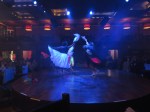
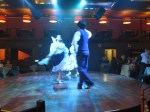
And then there was entertainment. 3-4 performers on stage at a time doing traditional dances from regions in Peru and various points in their history. The dancing was interesting to watch, but what made the program so unappealing was the smoke machine and strobe lights (yes, I said smoke machine and strobe lights.) It really distracted from the performances and the dancers were working so hard! They brought tourists up on the stage to dance with them, and after a dozen or so numbers, we just couldn’t take any more of the cheesiness.
5 hours later, at 3:30 AM, I headed to the airport for the second leg of this trip. More on Friday’s adventures in my next post.
 Lilla Travels